SIP in the UAE: monthly investment plans compared



A SIP (systematic investment plan) means investing the same amount every month, whatever the market does. In the UAE you can do it through a robo-adviser such as Sarwa, the recurring investment tools at eToro and Interactive Brokers, a bank monthly investment plan, National Bonds or an insurance-linked savings plan. Indian expats can also run a SIP in Indian mutual funds from the UAE.
The options differ most in three things: the minimum per month, the yearly cost and whether you can stop without a penalty. This guide compares them with figures taken from each provider and shows how much the cost difference adds up to over 20 years.
In short
- Most flexible: eToro and Interactive Brokers let you invest a fixed amount every month in stocks and ETFs, with no lock-in. eToro starts from $25 and charges no commission on recurring purchases.
- Most hands-off: Sarwa Invest builds and rebalances an ETF portfolio for you from $500, for 0.85% a year (minimum $7 a month) below $100,000.
- Bank plans: Emirates NBD's Monthly Investment Plan starts at AED 2,000 or USD 500 a month for 36 months, invested in funds.
- Fixed-profit savings: National Bonds starts at AED 100 a month. Its Second Salary plan targets an anticipated 3.25% a year.
- Insurance-linked plans: check the surrender schedule first. You have at least 30 days to cancel for a full refund.
- Costs matter: on AED 1,000 a month for 20 years, the gap between 0.2% and 2.5% a year in costs is about AED 100,000.
What is a SIP?
A SIP is a standing instruction to invest a fixed amount at a fixed interval, usually monthly. The term comes from Indian mutual funds. UAE banks call the same idea a monthly investment plan, brokers call it recurring investing and insurers sell regular savings plans.
Investing a fixed amount means you buy more units when prices are low and fewer when prices are high. This is called dollar-cost averaging. It does not protect you from losses. Its main benefit is that you keep investing without having to decide each month whether it is a good time.
A SIP is a method, not a product. What you end up owning depends on where the money goes: an ETF, a mutual fund, a savings certificate or an insurance policy. That choice decides your cost, your risk and how easily you can get your money back.
Monthly investment plans in the UAE compared
Here are the main ways to invest monthly from the UAE, with figures from each provider's own website in October 2026.
Sources: eToro, Interactive Brokers, Sarwa, Emirates NBD, Citi, ADIB and National Bonds. The table shows the provider's own fee. ETFs and funds also charge their own yearly expense ratio.
How to set up a monthly plan with eToro, Interactive Brokers or Sarwa
eToro: from $25 a month with no buying commission
eToro launched recurring investments in May 2025 and the UAE was in the first group of countries. You choose a stock or ETF, an amount and a day of the month. The order is placed automatically.
- Minimum: $25 for stocks and ETFs, $500 for Smart Portfolios and $200 to copy another investor.
- Frequency: once a month, on the day you choose.
- Cost: positions opened through a recurring plan pay no commission. Closing fees still apply when you sell stocks, and for UAE residents eToro charges $1 per trade on most exchanges and $2 on Dubai and Abu Dhabi stocks.
- Limits: up to $5,000 per transaction and $25,000 a month. Crypto recurring plans are not available in the UAE.
- How to start: open the asset page, tap the recurring investment banner, set the amount and date, choose the payment card and confirm.
eToro operates in the UAE through eToro (ME) Limited, regulated by the FSRA in Abu Dhabi Global Market. Read our eToro review or visit eToro.
Interactive Brokers: the widest choice of ETFs
IBKR's Recurring Investments feature buys a fixed cash amount of a stock or ETF on a schedule. It uses fractional shares, so the full amount gets invested even when one share costs more than your monthly budget.
- Instruments: US, Canadian and European stocks and ETFs that IBKR allows to trade in fractions. It publishes the list of eligible products.
- Frequency: daily, weekly, biweekly, monthly, quarterly or yearly.
- Cost: recurring orders use IBKR's Fixed pricing. On US stocks and ETFs the minimum commission is the lesser of $1 or 1% of the trade value, so a $300 monthly buy costs about $1. European exchanges have their own minimums.
- How to start: enable fractional share trading, then set up the plan in IBKR Mobile or the Client Portal.
IBKR suits investors who want to build their own ETF portfolio. Our guide to the best ETFs to invest in from the UAE explains why many UAE residents prefer Irish-domiciled funds. Read our Interactive Brokers review or open an account with IBKR.
Sarwa: a managed portfolio with auto-deposits
Sarwa Invest is a robo-adviser. You answer a questionnaire, Sarwa picks a portfolio of ETFs and rebalances it for you. Auto-deposits move a fixed amount from your bank to Sarwa on the schedule you choose, and the money is invested in your portfolio.
- Minimum: $500 for the Conventional and Halal portfolios and $2,500 for the Socially Responsible portfolio.
- Fees: 0.85% a year (minimum $7 a month) below $100,000, 0.7% from $100,000, 0.5% from $500,000 and 0.4% from $5 million.
- Portfolios: the Conventional portfolio uses Vanguard and BlackRock ETFs. The Halal portfolio holds sukuk, gold and ETFs.
- How to start: in the Sarwa app tap Fund, choose "Create an Auto-deposit", pick the account and your bank, then finish the standing instruction in your bank's app.
Sarwa Digital Wealth (Capital) Limited is regulated by the FSRA in Abu Dhabi Global Market. Read our Sarwa review, check the Sarwa promo code or visit Sarwa.
Other robo-advisers also serve UAE residents. StashAway, regulated by the DFSA, charges 0.8% a year on the first $25,000, falling in steps to 0.2% above $1 million. Wahed, regulated by the FSRA, runs Sharia-compliant portfolios for 0.99% a year on balances up to $250,000.
Bank monthly investment plans
Most large UAE banks offer a monthly plan into mutual funds. Emirates NBD's Monthly Investment Plan is a typical example:
- Minimum: AED 2,000 or USD 500 a month.
- Term: 36 months. At maturity you can stay invested with no additional subscription fees.
- Flexibility: two free switches or amendments a year, lump sums at any time and partial or full withdrawals with no exit charge.
Other banks run similar plans. Citi's monthly plan into mutual funds also runs for 36 months, and you can stop before the end without exit or surrender charges. ADIB's Khuttati is a Sharia-compliant plan into Islamic equity funds, sukuk funds or ready-made portfolios, from AED 1,000 a month. It charges a one-time upfront fee and can be cancelled at any time.
The convenience is real, since everything sits in the account where your salary arrives. The cost is the weak point. Actively managed funds sold through banks usually carry higher yearly expense ratios than index ETFs, so ask for each fund's factsheet and total yearly charges before you sign.
National Bonds: fixed-profit monthly saving
National Bonds is a Sharia-compliant savings scheme owned by the Investment Corporation of Dubai. It is not invested in the stock market, so the value does not go up and down with prices. Residents and non-residents can open an account with a passport.
- My Plan: from AED 100 a month by direct debit, with no end date. Profit is paid once a year. If you stop before 12 payments, a 0.5% subscription fee on the planned amount applies (minimum AED 15).
- Second Salary: from AED 1,000 a month for 3 to 20 years, with an anticipated profit rate of 3.25% a year. After the term it pays you a monthly income. Early cancellation may cost you charges.
National Bonds suits short goals and emergency savings. For goals 10 or more years away, a profit rate around 3% leaves little room above inflation. Compare it with our list of the best savings accounts in the UAE.
Insurance-linked savings plans: what to check before you sign
Many expats are offered a regular savings plan by an adviser or a bank. These are life insurance policies that invest your monthly premium in funds. They usually run for many years, and stopping early can cost a large part of what you paid.
The UAE's rules for these products are in the Insurance Authority's Board Decision No. 49 of 2019, now applied by the Central Bank of the UAE. They give you these protections:
- Free-look period: at least 30 calendar days to cancel and get your full premium back, without giving a reason.
- Surrender schedule: the surrender charges and surrender values must be on a separate page, in red font, which you sign separately.
- Commission limits: the first-year commission paid to the adviser is capped at 50% of the annualised premium, and the rest is spread over the payment term.
- Realistic illustrations: projected returns cannot assume more than three-month EIBOR plus 4%.
- Low-protection warning: if the plan has little or no life cover, a warning in bold red must say so, with your signature below it.
Before signing, read the red surrender page and ask one question: how much would I get back if I stopped after two years? If the answer is a small part of what you paid, a flexible plan at a broker is likely the cheaper path. Our guide to financial advisors in Dubai explains how advisers are paid.
SIP in Indian mutual funds from the UAE
Indian residents of the UAE often want to keep investing at home. As a non-resident Indian (NRI) you can start a SIP in Indian mutual funds while living in the UAE.
- Bank account: you need an NRE or NRO account in India. NRE balances can be sent back abroad freely. NRO balances have a repatriation limit of USD 1 million per financial year.
- KYC: passport, PAN card, overseas address proof and a photograph. Some fund houses ask for video KYC.
- Tax in India: for equity-oriented funds sold on or after 23 July 2024, short-term gains are taxed at 20% and long-term gains at 12.5%. Tax is deducted at source on payments to NRIs.
Source: Tata Mutual Fund. The UAE does not tax the gains, but the India-UAE tax treaty and your residency status can change what you owe in India, so check your case with a tax adviser.
How much do costs take from a monthly plan?
The yearly cost is the one number that keeps working against you for the whole plan. To show the effect, we assumed AED 1,000 a month for 20 years and a return of 6% a year before costs. This is an illustration, not a forecast.
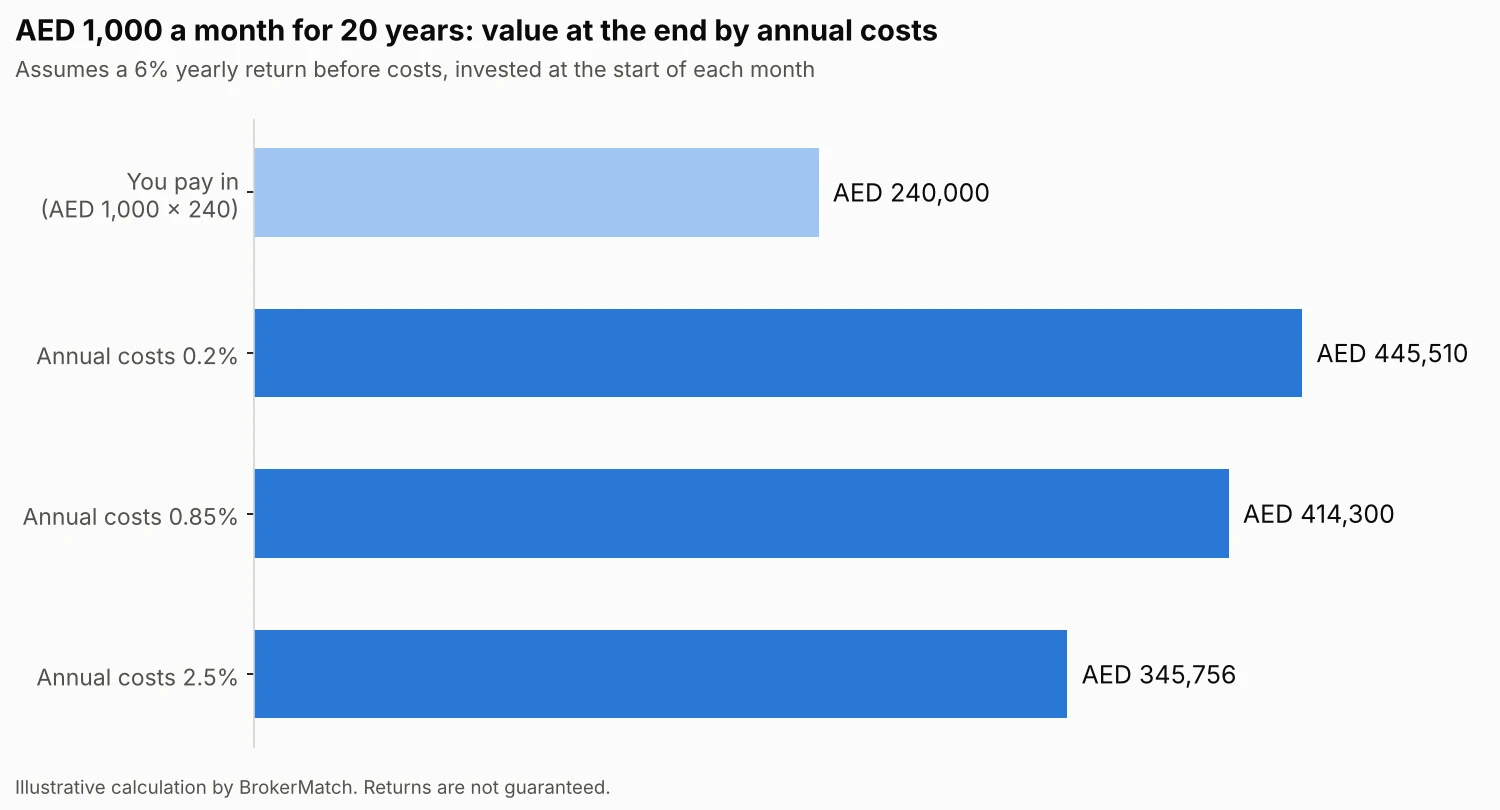
You pay in AED 240,000 in all three cases. With costs of 0.2% a year, typical for a do-it-yourself portfolio of index ETFs, you end with AED 445,510. At 0.85% you end with AED 414,300. At 2.5%, a level some actively managed funds and insurance-linked plans reach once all charges are added, you end with AED 345,756, about AED 100,000 less than the low-cost option. You can test your own numbers in our SIP calculator.
Can you start a SIP with AED 500 a month?
Yes, but not everywhere. Emirates NBD's plan starts at AED 2,000 a month and ADIB's at AED 1,000. With AED 500 your options are a recurring plan at eToro (from $25) or Interactive Brokers, auto-deposits into Sarwa once you hold the $500 minimum, or National Bonds My Plan from AED 100.
AED 500 a month invested at the start of each month, before costs. This is an illustration, not a forecast. Source: BrokerMatch calculation.
Fixed fees weigh more on small amounts:
- Commissions: at IBKR the $1 minimum commission is about 0.7% of a AED 500 (about $136) monthly buy. At eToro recurring purchases pay no commission, but you pay $1 per trade when you sell US stocks.
- Minimum fees: Sarwa's $7 monthly minimum is a large share of a small portfolio. On a $2,000 balance it equals 4.2% a year, and only from about $9,900 does the 0.85% rate apply.
- Funding: Sarwa charges 2.99% plus AED 1 on deposits with a UAE debit card, while AED transfers from a UAE bank are free. It converts AED to USD at 3.6823, about 0.27% away from the official peg of 3.6725, according to its help centre. Check the funding and conversion costs of any platform before you set up the plan.
SIP, lump sum or step-up SIP?
If the money is already in your account, investing it all at once has usually done better than spreading it out. Vanguard's 2023 research on the MSCI World index from 1976 to 2022 found that a lump sum beat one-year cost averaging 68% of the time, because markets rise more often than they fall. A SIP makes most sense when the money comes from your salary each month, or when spreading the entry is what gets you to invest at all.
A step-up SIP raises the monthly amount each year, usually in line with pay rises. If you start with AED 500 and add 10% every year for 20 years, you pay in AED 343,650. At 6% a year before costs, the plan would end at about AED 545,000, compared with AED 227,823 if you kept AED 500 flat. At a broker or robo-adviser you can stop the plan and set up a new one with a higher amount at any time. Bank plans may limit changes: Emirates NBD allows two free amendments a year.
Which monthly plan fits you?
- You want low costs and control: a recurring plan into a global ETF at Interactive Brokers or eToro.
- You want someone else to pick and rebalance: Sarwa Invest, including a Halal portfolio.
- You want a Sharia-compliant plan: Sarwa's Halal portfolio, ADIB Khuttati, Wahed or National Bonds.
- You want a fixed profit and no market swings: National Bonds, for shorter goals.
- You are an NRI saving for goals in India: a SIP in Indian mutual funds through an NRE account.
- You were offered an insurance savings plan: use the 30-day free-look period to compare its total costs and surrender values with the options above.
For a wider view of where to put your money, see our guide to the best investments in the UAE for expats. If you prefer buying UAE stocks, read how to buy shares in the UAE.
Taxes on monthly investing in the UAE
Individuals in the UAE pay no personal income tax and no capital gains tax on investments held for their own account. Foreign taxes can still apply. US stocks and US-listed ETFs have 30% withheld from dividends paid to UAE residents, as explained in our guide to investing in US stocks from the UAE. Indian mutual funds are taxed in India, as shown above.
Bottom line
The cheapest way to run a SIP from the UAE is a recurring plan into a low-cost ETF. eToro starts from $25 a month with no buying commission and Interactive Brokers offers the widest ETF choice from about $1 per order. If you prefer a managed portfolio, Sarwa does the work for 0.85% a year below $100,000.
Bank plans and National Bonds trade some return for convenience or a fixed profit. With insurance-linked plans, read the surrender page before anything else. On AED 1,000 a month over 20 years, the difference between 0.2% and 2.5% in yearly costs is about AED 100,000.
Frequently asked questions
Can expats do a SIP in the UAE?
Yes. Expats can set up recurring investments at eToro, Interactive Brokers or Sarwa, join a bank monthly investment plan or save with National Bonds. Indian expats can also keep a SIP in Indian mutual funds through an NRE or NRO account.
Which SIP is best in the UAE?
It depends on your goal and how hands-on you want to be. For long-term goals, a recurring plan into a low-cost global ETF keeps costs lowest. For a fixed profit with no market risk, National Bonds is the simplest option. Compare platforms side by side in our broker comparison tool.
What is the minimum amount to start a SIP in the UAE?
eToro recurring investments start at $25 a month and National Bonds My Plan at AED 100 a month. Sarwa Invest needs a $500 balance and Emirates NBD's Monthly Investment Plan starts at AED 2,000 or USD 500 a month.
Can I stop a SIP at any time?
At eToro, Interactive Brokers and Sarwa you can pause or cancel without a penalty. National Bonds My Plan charges a 0.5% fee if you stop before 12 payments. Insurance-linked plans can charge surrender fees for many years, so check the surrender schedule.
Can I increase my SIP amount later?
Yes. At eToro, Interactive Brokers and Sarwa you can stop the plan and set up a new one with a higher amount at any time. Bank plans may limit changes: Emirates NBD allows two free switches or amendments a year. Raising the amount by 10% a year turns AED 500 a month into about AED 545,000 after 20 years at 6% before costs, against AED 227,823 without increases.
Is a SIP better than a fixed deposit?
They do different jobs. A fixed deposit pays a known rate and keeps your capital stable, which suits money you need within a few years. A SIP in stocks or ETFs can grow more over long periods but can also lose value. Our fixed deposit calculator helps you compare.
How much will AED 1,000 a month grow to?
Over 20 years you pay in AED 240,000. At a 6% yearly return before costs, the end value ranges from about AED 346,000 to AED 446,000 depending on costs of 2.5% to 0.2% a year. Returns are not guaranteed.