UAE Retail T-Sukuk: how to invest from AED 1,000



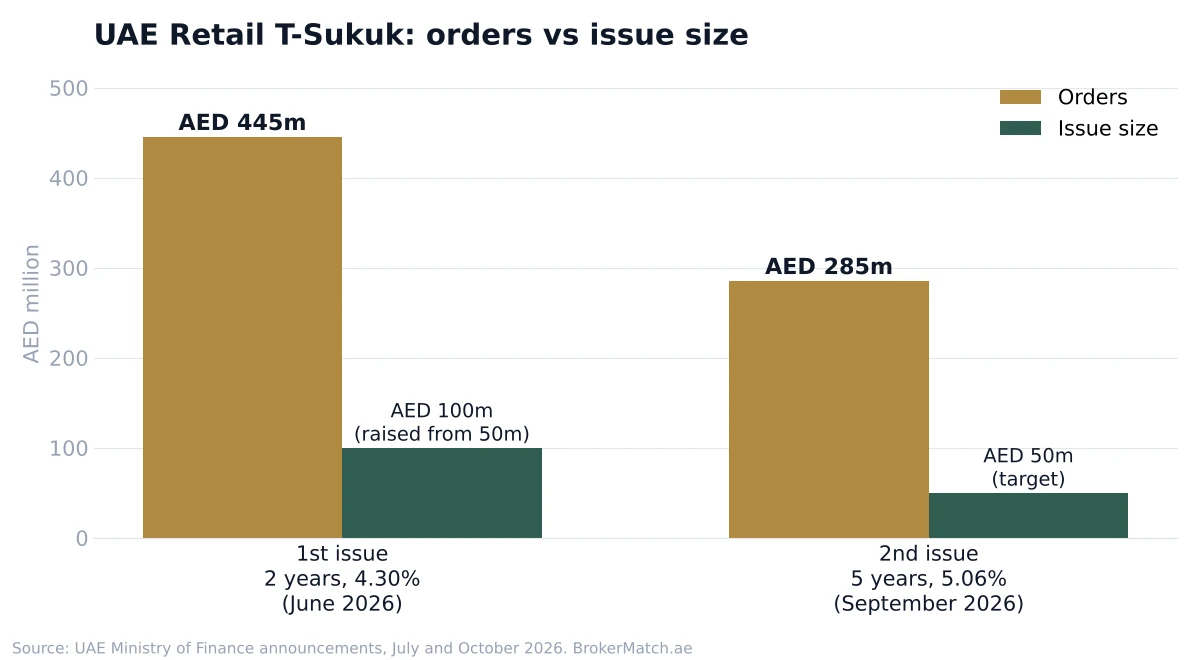
The UAE Retail T-Sukuk lets individuals lend money to the federal government from AED 1,000 and earn a fixed profit every six months. The second issue, sold in September 2026, pays 5.06% a year for five years. It drew AED 285 million in orders for an AED 50 million target.
This guide explains how the programme works, who can apply, how to subscribe step by step, what you earn, how to sell before maturity and how the T-Sukuk compares with fixed deposits and National Bonds. We update it with each new issue.
In short
- What it is: Shariah-compliant sukuk issued in dirhams by the UAE Ministry of Finance and backed by the federal government. You get a fixed profit rate, paid twice a year, and your money back at maturity.
- Issues so far: a two-year issue at 4.30% in June 2026 and a five-year issue at 5.06% in September 2026.
- Who can subscribe: UAE nationals and residents with a valid Emirates ID and a DFM National Investor Number (NIN). Non-residents, companies and minors can only buy on the secondary market.
- How: through the DFM app, the iVestor app, the DFM online subscription platform or the digital channels of the receiving banks, during a subscription window that lasts about a week.
- Costs and tax: no subscription fee and no UAE tax on the profit for individuals. Brokerage fees apply if you trade the sukuk later.
- Selling early: the issuer does not redeem early, but you can sell on Nasdaq Dubai at the market price, which can be above or below what you paid.
What is the UAE Retail T-Sukuk?
A sukuk is the Islamic finance equivalent of a bond. Instead of paying interest, the issuer pays a profit linked to assets or contracts that comply with Shariah principles. For the investor the result looks much like a government bond: you invest a fixed amount, receive a fixed profit on set dates and get the full amount back at maturity.
The T-Sukuk (Treasury Sukuk) are issued by the UAE Ministry of Finance. Until late 2025 they were sold only to banks and institutions. The Sovereign Retail T-Sukuk Programme, launched in 2026 with the Central Bank of the UAE, opened new issues to individuals with a minimum of AED 1,000, in multiples of AED 1,000. According to the programme FAQ, each sukuk is a direct obligation of the UAE Government, acting through the Ministry of Finance.
After each subscription the sukuk are listed on Nasdaq Dubai, so you can hold them to maturity or sell them earlier on the exchange.
Retail T-Sukuk issues so far
| Issue | Profit rate | Tenor | Orders | Size |
|---|---|---|---|---|
| 1st (June 2026) | 4.30% a year | 2 years | AED 445 million | AED 100 million (raised from AED 50 million) |
| 2nd (September 2026) | 5.06% a year | 5 years (matures 30 September 2031) | AED 285 million | AED 50 million target |
Sources: Ministry of Finance announcements of 2 July and 2 October 2026, published by DFM and Zawya. Maturity of the 2nd issue as reported by Reuters on 2 October 2026.
First issue: subscriptions ran from 24 to 30 June 2026 and trading on Nasdaq Dubai started on 2 July. Demand reached nearly nine times the original AED 50 million, so the Ministry doubled the issue to AED 100 million. Investors who applied for AED 10,000 or less made up 76% of subscribers and UAE nationals 72%.
Second issue: subscriptions ran from 23 to 28 September 2026, with allocation on 29 September and listing on Nasdaq Dubai in early October. Orders were 5.7 times the target. Subscribers came from 110 nationalities and nearly half had already invested in the first issue. The Ministry has not published the final amount issued.
The programme FAQ says the Ministry plans to issue at least once a quarter, with tenors of up to seven years, either as T-Sukuk or as conventional Treasury bonds. Dates and rates of new issues appear on the Ministry's issuance programme page.
How much do you earn?
The profit rate is fixed for the whole tenor and paid every six months into the account you registered. Each issue gets its own rate, set according to market conditions when it is launched.
Example: AED 10,000 in the second issue at 5.06% pays AED 506 a year, in two payments of AED 253. Over five years that adds up to AED 2,530 in profit, and you receive the AED 10,000 back on 30 September 2031. The minimum AED 1,000 pays AED 50.60 a year.
Here is what different amounts earn in the second issue, before any brokerage or custody fees:
| Invested | Every six months | Per year | Over 5 years |
|---|---|---|---|
| AED 1,000 | AED 25.30 | AED 50.60 | AED 253 |
| AED 10,000 | AED 253 | AED 506 | AED 2,530 |
| AED 50,000 | AED 1,265 | AED 2,530 | AED 12,650 |
| AED 100,000 | AED 2,530 | AED 5,060 | AED 25,300 |
Calculated at the 5.06% annual profit rate, paid in two equal payments a year, assuming you receive the full amount you applied for.
In the first issue, AED 10,000 at 4.30% pays AED 215 every six months, so AED 860 over the two years.
Two details can lower what you actually earn:
- Allocation: when an issue is oversubscribed, orders are scaled back pro rata. You may receive fewer sukuk than you asked for and the rest of your money is refunded.
- Buying on the secondary market: if you buy after listing above AED 1,000 per unit, your real yield is lower than the profit rate. If you buy below AED 1,000, it is higher.
Who can invest?
- Can subscribe to new issues: UAE nationals and UAE residents with a valid Emirates ID and a valid DFM investor number. The programme is for individual retail investors only.
- Cannot subscribe: non-residents, companies, minors and professional investors. Non-residents, companies and minors can still buy and sell the sukuk on the secondary market through Nasdaq Dubai brokers.
There is no maximum subscription. The Ministry can reduce large orders at its discretion.
How to invest in the Retail T-Sukuk, step by step
Step 1: Get your DFM investor number (NIN)
You need a NIN to subscribe. If you have never bought UAE shares or taken part in an IPO, apply in the DFM app with your Emirates ID, in the iVestor app or through a licensed broker. The app asks you to scan your ID, take a selfie, add your address and choose how you want to receive cash payments: on an iVestor prepaid card or by bank transfer. Our guide on how to buy shares in the UAE covers the NIN in more detail.
Apply before the subscription window opens. The windows are short and you cannot subscribe without the number.
Step 2: Wait for the next subscription window
The Ministry announces each issue a few days before subscriptions open, and the profit rate a day or two before. The first two windows lasted about a week each. Check the Ministry's Retail T-Sukuk page for the current issue and its term sheet.

Step 3: Subscribe through an app or your bank
During the window you can subscribe through any of these channels:
- DFM app: under IPO / Sukuk Subscriptions.
- iVestor app: under Subscriptions, paying with your iVestor card.
- DFM online subscription platform: through the DFM e-Services portal.
- Receiving banks: the digital channels of Emirates NBD (lead bank), Emirates Islamic, Abu Dhabi Islamic Bank, Ajman Bank, Mashreq, Abu Dhabi Commercial Bank and First Abu Dhabi Bank, as listed for the second issue.
The process is fully digital. You buy at par, which means AED 1,000 per sukuk, and pay no subscription fee.
Step 4: Check your allocation
Allocation takes place the day after the window closes. The sukuk are credited to your investor account before listing and any excess money is refunded. For the second issue, allocation was on 29 September and refunds and issuance on 30 September 2026.
Step 5: Hold to maturity or sell
If you hold, you do nothing: the profit arrives every six months and the principal is credited automatically at maturity. If you want to sell, see the next section.
Selling before maturity and buying after the subscription
The Ministry does not buy the sukuk back early. To get your money before maturity you sell on Nasdaq Dubai, either through a trading account in the iVestor app or through a Nasdaq Dubai broker member. You search the sukuk by name or symbol, choose Sell and enter the quantity.
The price depends on supply and demand. Market makers quote prices to support trading, but there is no guaranteed buyer. If interest rates rise after you buy, the price of a fixed-rate sukuk tends to fall, and the opposite when rates fall. The longer the tenor, the bigger this effect, so the five-year issue moves more than the two-year one.
The same route works in the other direction. If you missed the subscription, or you are not eligible to subscribe, you can buy listed T-Sukuk on Nasdaq Dubai at the market price. Brokerage, exchange and custody fees apply to these trades, according to each provider's tariff.
Fractionalised T-Sukuk through your bank
The Ministry runs a second retail channel, launched in late 2025. It sells fractions of T-Sukuk that already trade in the market, from AED 4,000, through the apps of participating banks such as ADIB and Emirates NBD. You can choose among maturities from less than one year up to five years. Prices follow the market, so you do not buy at par, and the profit follows the schedule of the underlying sukuk. The Ministry lists a 0.25% fee to buy and 0.25% to sell, with no fee at maturity. It is open to UAE citizens and residents with an Emirates ID, subject to each bank's terms.
Check the exit rules before you buy. At Emirates Islamic, for example, the fractional sukuk can only be sold back through the bank and cannot be transferred to another provider. The bank also charges custody and transaction fees under its own tariff.
Costs, tax and zakat
- Subscription: free.
- Trading and custody: brokerage, exchange or custody fees may apply when you buy or sell after listing.
- Tax: the UAE has no personal income tax, so the Ministry says profit payments and the repayment at maturity are not subject to local income tax. VAT may apply to fees charged by banks or brokers. If you are tax resident in another country, check whether it taxes this income.
- Zakat: if you pay zakat on your savings and investments, our zakat calculator helps you work out the amount.
Risks to know before you invest
- Credit risk: low, since the sukuk are a direct obligation of the federal government. In 2026 Fitch affirmed the UAE at AA- and Moody's at Aa2, both with a stable outlook.
- Price risk: if you sell before maturity you may get less than AED 1,000 per sukuk.
- Liquidity: you can only exit by selling on the exchange, and the issues are small, so a large sale may move the price.
- Locked rate: the profit rate does not change. If deposit rates rise, your money stays at the original rate unless you sell.
- Partial allocation: in an oversubscribed issue you may get only part of the amount you applied for.
T-Sukuk, fixed deposits or National Bonds?
Residents looking for a safe return in dirhams usually compare three options.
| Retail T-Sukuk | Fixed deposit | National Bonds | |
|---|---|---|---|
| Return | 5.06% fixed for 5 years (2nd issue) | Up to about 5% for 12 months | Annual profit, not fixed in advance, plus prize draws |
| Minimum | AED 1,000 | Depends on the bank | AED 100 |
| Exit before the end | Sell on Nasdaq Dubai at market price | Usually with a penalty on the profit | After a 30-day lock-in |
| Who can invest | Nationals and residents (subscription) | Bank customers | Residents and non-residents |
| When | Only during subscription windows | Any time | Any time |
Fixed deposit rate: DIB's 12-month Monthly Profit Payment Wakala (5.05% expected profit) and RAKBANK's Fixed Deposit Plus (4.94%), from our fixed deposit rates comparison of 19 October 2026. National Bonds terms from the Saving Sukuk product page.
The T-Sukuk stands out for locking a fixed rate for several years with government backing. A fixed deposit gives similar returns today, but only for a year, and the rate on renewal depends on where EIBOR and bank rates go (see the EIBOR rate today). National Bonds suit small, regular savings and people who are not resident in the UAE, but the profit is not fixed in advance. For cash you may need at short notice, the best savings accounts in the UAE are more flexible.
Is the Retail T-Sukuk worth it?
For money you will not need for several years and want to keep safe, the T-Sukuk is one of the simplest options in the UAE. The second issue pays 5.06% fixed until 2031, backed by the federal government, with no fees to subscribe and no tax for individuals.
It fits less well if you may need the money soon, since selling early exposes you to the market price. It is also a poor fit for long-term growth. Over decades, a diversified portfolio of shares has historically returned more than government debt, with more ups and downs along the way. If that is your goal, start with our guides to the best ETFs to invest in from the UAE and the broker comparator, and keep the sukuk for the stable part of your savings.
Bottom line
To invest in the UAE Retail T-Sukuk, get a DFM investor number in the DFM app, wait for the next subscription window and apply from AED 1,000 through the DFM or iVestor apps or your bank. The second issue pays 5.06% a year for five years, in two payments a year, and you get your money back on 30 September 2031. If you miss a window or you are not a resident, you can still buy listed T-Sukuk on Nasdaq Dubai at the market price.
Frequently asked questions
What is the minimum investment in the UAE Retail T-Sukuk?
AED 1,000, which is one sukuk. Above that you invest in multiples of AED 1,000. There is no maximum, but the Ministry can scale back large orders.
Can expats invest in the T-Sukuk?
Yes, if they live in the UAE. Residents with a valid Emirates ID and a DFM investor number can subscribe to new issues, whatever their nationality. The second issue drew subscribers from 110 nationalities.
Can non-residents buy UAE T-Sukuk?
Not in the subscription. Non-residents can buy listed T-Sukuk on the secondary market through a Nasdaq Dubai broker, at the market price.
When is the next Retail T-Sukuk issue?
The Ministry has not announced the date of the third issue. Its FAQ says it plans to issue at least once a quarter, with tenors of up to seven years. New issues appear on the Ministry's Retail T-Sukuk and issuance programme pages, usually a few days before subscriptions open.
How is the profit paid?
Every six months, into the account linked to your investor number: your iVestor card or the bank account you registered. The rate stays the same until maturity.
Can I get my money back before maturity?
Not from the Ministry. You can sell your sukuk on Nasdaq Dubai at any time after listing, but the price may be higher or lower than AED 1,000.
Is the Retail T-Sukuk halal?
The programme FAQ says the sukuk are structured in line with Shariah principles and approved under the applicable Shariah governance framework. The offering documents on the Ministry's website describe the structure.
Do I pay tax on the profit?
Not in the UAE, since no tax currently applies to this income for individuals. If you are tax resident elsewhere, your home country may tax it.
This article is for general information and is not investment advice. Details were checked against the Ministry of Finance, DFM and issuer announcements in October 2026 and can change with each new issue.