How to invest in US stocks from the UAE


The US stock market is the largest and most liquid in the world, home to some of the most innovative companies — from Apple and Microsoft to Tesla and Amazon. For UAE residents and expats, investing in US stocks is one of the smartest ways to diversify your portfolio and build long-term wealth.
This guide will walk you through everything you need to know to start investing in US stocks from the UAE, from choosing the right broker and understanding your options to managing taxes and placing your first trade.
Video summary
If you prefer video content, watch a short overview on investing in the US market from the UAE below:
Why invest in US stocks?
Before diving into the how, let's understand why the US market is so attractive for UAE-based investors:
- Global diversification: The UAE economy is heavily tied to oil and real estate. US stocks give you exposure to sectors like technology, healthcare, consumer goods, and financial services — spreading your risk across different industries and geographies.
- Proven long-term growth: Historically, the US stock market has delivered average annual returns of around 10% over the long term (before inflation). Indices like the S&P 500 have consistently recovered from downturns and reached new highs.
- Access to world-class companies: From tech giants like Apple and Google to consumer brands like Nike and Coca-Cola, the US market offers access to companies that shape the global economy.
- Liquidity and transparency: The NYSE and NASDAQ are highly regulated exchanges with deep liquidity, tight spreads, and robust investor protections.
- No local tax on gains: UAE residents pay zero personal income tax and zero capital gains tax on personal investments, making it one of the most tax-friendly environments in the world for stock investors.
Ways to invest in US stocks from the UAE
There are several ways to gain exposure to the US stock market. The right approach depends on your goals, experience, and how involved you want to be:
1. Individual US stocks
Buying shares of specific companies like Apple (AAPL), Amazon (AMZN), or Tesla (TSLA) gives you direct ownership. This is ideal if you want to pick your own investments and are comfortable doing research. Many brokers available in the UAE allow you to buy US-listed stocks with no commission.
2. US-focused ETFs
Exchange-Traded Funds (ETFs) bundle multiple stocks into a single investment. For example, an S&P 500 ETF gives you exposure to 500 of the largest US companies in one trade. ETFs are a great choice for diversification with lower effort.
For UAE investors, Irish-domiciled (UCITS) ETFs are generally preferred over US-domiciled funds due to tax advantages (more on this below). Check our list of the best ETFs to invest in from the UAE for specific recommendations.
3. Fractional shares
Some brokers, like Interactive Brokers and eToro, allow you to buy a fraction of a share. This means you can invest in expensive stocks like Berkshire Hathaway or Amazon with as little as $1 — perfect for beginners who want to start small.
4. Mutual funds and robo-advisors
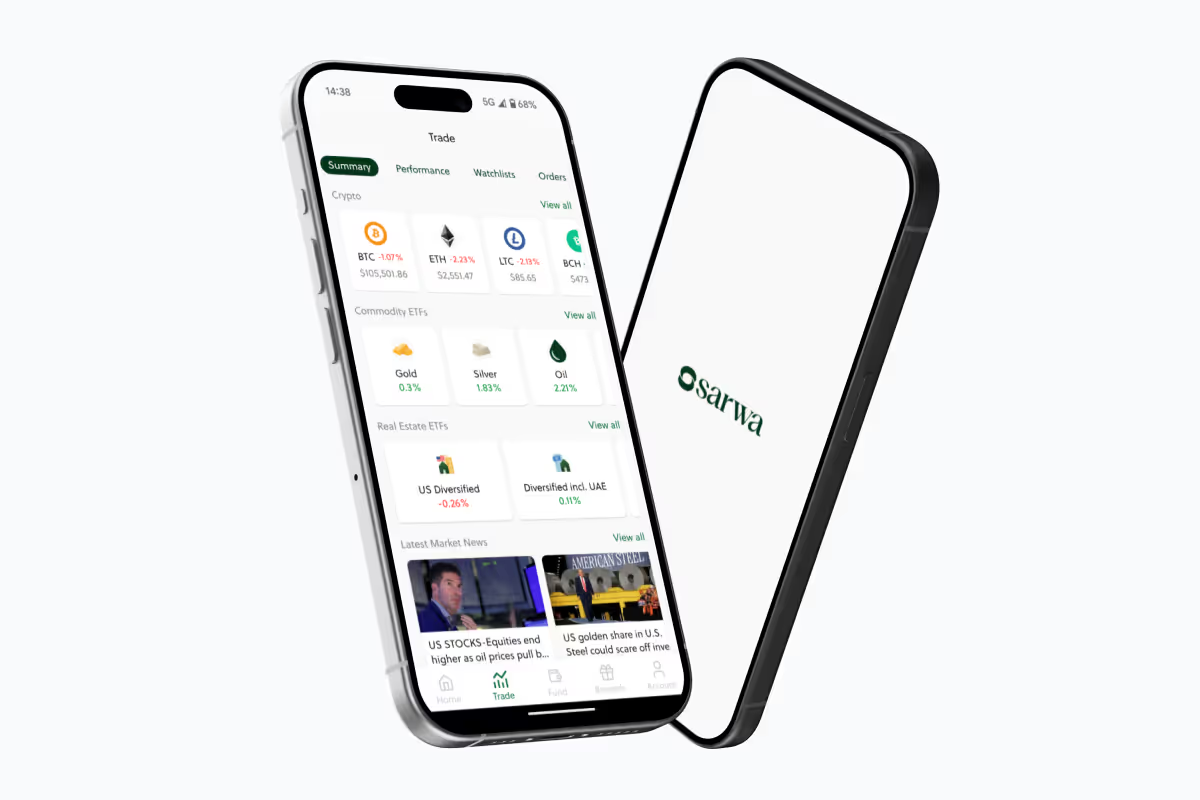
If you prefer a hands-off approach, robo-advisors like Sarwa build and manage a diversified portfolio for you, which typically includes significant US stock exposure. This is ideal for beginners or those who don't have the time to manage their own portfolio.
CFDs vs. real shares: know what you're buying
Before you place your first trade, make sure you understand the difference between buying real shares and trading CFDs (Contracts for Difference) — because some brokers in the UAE offer both, and they are very different products.
Real shares mean you actually own a piece of the company. You're a shareholder, you receive dividends, and there's no expiry on your position. Your shares are held in a custodial account, often protected by investor compensation schemes (like SIPC in the US or ICF in Europe). This is what most long-term investors want.
CFDs are derivative contracts that mirror the price of the underlying stock, but you don't own anything. CFDs are leveraged products — meaning you can lose more than your initial deposit — and they come with overnight financing fees that make them expensive to hold long-term. CFDs are designed for short-term speculation, not investing.
Here's a quick comparison:
| Real Shares | CFDs | |
|---|---|---|
| Ownership | Yes — you own the stock | No — it's a contract with the broker |
| Dividends | Yes, paid directly | Dividend adjustments (may differ) |
| Leverage | No (1:1) | Yes (e.g. 1:5 or higher) |
| Overnight fees | None | Yes — daily financing charges |
| Ideal for | Long-term investing | Short-term trading / speculation |
| Risk | Limited to your investment | Can exceed your deposit |
Bottom line: If you're investing in US stocks for the long term, always make sure you're buying real shares, not CFDs. Brokers like Interactive Brokers and Sarwa only offer real shares. Others like eToro and XTB offer both — just make sure you select the "real stock" option and not the CFD when placing your order. For more context, see our guide on CFD brokers in the UAE.
Choose the right broker
Picking the right broker is the most important step. Here are the top platforms for buying US stocks from the UAE:
| Broker | US Stock Fees | Min. Deposit | Fractional Shares | Islamic Account |
|---|---|---|---|---|
| Interactive Brokers | From $0.0035/share (min $0.35) | $0 | Yes | No |
| eToro | $0 commission (spread applies) | $100 | Yes | Yes |
| Sarwa Trade | Greater of $1 or 0.25% per trade | $1 | Yes | Yes |
| XTB | 0% up to EUR 100,000/month turnover, then 0.2% (min EUR 10) | $0 | Yes | No |
| Freedom24 | From $0.02/share (min $2) | $0 | No | No |
| Trading 212 | $0 commission | $10 | Yes | No |
Interactive Brokers (IBKR) is the most popular choice among experienced investors in the UAE. It offers the widest range of markets, very low fees, excellent currency exchange rates, and access to the London Stock Exchange (LSE) where Irish-domiciled ETFs are listed. For commission-free, beginner-friendly investing under FCA regulation, Trading 212 is also a strong option.
Sarwa is a great UAE-based alternative for beginners — simple to use and offering both a DIY trading platform and a managed robo-advisor portfolio. New users can earn a welcome bonus worth up to AED 3,000.
Want to explore more options? Check the full list of regulated brokers in the UAE and our individual broker reviews. You can also browse the best trading platforms in the UAE for a broader comparison.
How to buy US stocks: step by step
Here's how to go from zero to your first US stock purchase. We'll use Interactive Brokers as an example, but the process is similar with most brokers (eToro, Sarwa, Trading 212, XTB).
Step 1: Open a brokerage account
Visit your chosen broker's website and sign up. You'll need to provide:
- Passport or Emirates ID
- Proof of address (utility bill or bank statement)
- Source of funds information
Most brokers approve accounts within 1–5 business days. The process is fully online.
Step 2: Fund your account
Transfer money to your brokerage account. Most brokers accept bank wire transfers in AED or USD. Since the AED is pegged to the US dollar (at approximately 3.6725 AED per 1 USD), currency conversion is straightforward and stable.
Tip: Interactive Brokers now supports local AED funding in the UAE, making deposits faster and cheaper.
Step 3: Search for the stock or ETF
Use the broker's search bar to find the company or ETF you want to invest in. For example, search for "AAPL" for Apple or "CSPX" for an S&P 500 ETF.

Step 4: Place a buy order
Click "Buy" and choose your order type:
- Market order: Executes immediately at the current market price. Simple but you might pay slightly more than expected.
- Limit order: You set the maximum price you're willing to pay. The order only executes if the price drops to your level. This gives you more control.
Then enter the number of shares (or dollar amount if fractional shares are available) and submit.

Step 5: Monitor and manage your portfolio
Once the order is filled, the stock or ETF will appear in your portfolio. You can track performance, set alerts, and decide when to add more or rebalance.
Tax considerations for UAE investors
One of the biggest advantages of investing from the UAE is the favourable tax environment. However, there are still some important things to know:
No local taxes on investments
The UAE does not charge personal income tax, capital gains tax or dividend tax on individuals. Profits from selling US stocks in a personal capacity are yours to keep. Under Cabinet Decision No. 49 of 2023, income from personal investment — investing for your own account, where the activity is not conducted through and does not require a UAE licence — is excluded from UAE corporate tax regardless of amount, so the 9% corporate tax rate applies to business activity rather than to an individual's portfolio. The securities themselves are exempt from the 5% VAT, though explicit brokerage fees and commissions charged by UAE-based providers are standard-rated. If you invest through a company or trade as a licensed business, take advice on whether corporate tax applies to you.
US dividend withholding tax
While the UAE doesn't tax you, the US does — but only on dividends:
- US-listed stocks and ETFs: A 30% withholding tax is applied to dividends at source. There is no income tax treaty between the United States and the UAE, so no reduced treaty rate is available and UAE residents pay the full 30% on US-source dividends.
- Irish-domiciled ETFs: Thanks to the US–Ireland tax treaty, the withholding rate is reduced to 15%. This is one of the key reasons Irish UCITS ETFs are recommended for non-US investors.
US estate tax
If a non-US person holds more than $60,000 in US-situated assets (including US-listed stocks and ETFs) at death, the estate may owe US estate tax at rates rising to 40%. The $60,000 figure comes from a fixed $13,000 unified credit written into the tax code — unlike the exemption for US citizens and residents, which is $15 million per person in 2026 and indexed annually, the non-resident threshold has never been indexed and was left unchanged by the 2025 tax legislation. Crossing $60,000 also triggers a US estate tax return (Form 706-NA), which is a filing burden on your heirs even where little or no tax ends up being due. Shares in Irish-domiciled UCITS ETFs are not US-situated assets, so they fall outside this entirely — another strong reason for UAE residents to prefer them.
W-8BEN form
When opening an account with most international brokers (Interactive Brokers, eToro, Sarwa, Trading 212), you will be asked to complete a W-8BEN form. It certifies that you are not a US person for tax purposes. Because there is no US–UAE tax treaty, the W-8BEN does not reduce your dividend withholding below 30% the way it would for a resident of a treaty country — what it does is establish your foreign status so the correct non-resident regime applies instead of US backup withholding, and it keeps your account in good standing. The form is completed online during account opening, usually in a couple of minutes, and it is mandatory if you hold US stocks or ETFs. It has to be renewed roughly every three years.
Key takeaway: For individual US stocks, the 30% dividend withholding and potential estate tax are unavoidable. For broader market exposure, Irish-domiciled ETFs offer a more tax-efficient alternative. Learn more about this in our guide on how to invest in the S&P 500 from the UAE.
What to look for when choosing US stocks
Not all stocks are created equal. When selecting individual US stocks, keep these factors in mind:
- Company fundamentals: Look at revenue growth, profit margins, earnings per share (EPS), and debt levels. Strong fundamentals signal a healthy business.
- Valuation: Check the P/E ratio, P/S ratio, and other metrics. A great company can be a bad investment if it's overpriced.
- Sector trends: Technology, healthcare, and clean energy have been strong performers — but diversifying across sectors reduces your overall risk.
- Dividend history: If you want income, look for companies with a track record of consistent, growing dividends (e.g. Johnson & Johnson, Procter & Gamble, Coca-Cola).
- Market conditions: Interest rates, inflation, and geopolitical events can significantly impact stock prices in the short term. Stay aware of the macro picture.
Practical tips for success
Investing in US stocks from the UAE can be highly rewarding if you approach it with discipline. Here are the key habits of successful investors:
- Start small and learn: Many brokers offer fractional shares, so you can begin with as little as $1. Use this to get comfortable before committing larger amounts.
- Diversify: Don't put everything in one stock. A mix of individual stocks and ETFs across different sectors is a solid approach. Check the best investments in the UAE for expats for more ideas.
- Use dollar-cost averaging: Invest a fixed amount at regular intervals (e.g. monthly) instead of all at once. This smooths out volatility and reduces the risk of buying at peaks.
- Think long-term: Short-term market movements are unpredictable, but over 10–30 years the US market has consistently grown. Patience is the most reliable edge.
- Watch your fees: Trading commissions, currency conversion, and account charges add up. Choose a broker with transparent pricing — see the best trading apps in the UAE.
- Stay informed: Follow earnings reports and market news. Resources like investing podcasts, finance blogs, and YouTube channels can help you stay sharp.
Bottom line
Investing in US stocks from the UAE is more accessible than ever. With zero local taxes, a stable currency pegged to the dollar, and a wide selection of international brokers serving UAE residents, you have everything you need to start building wealth through the world's largest stock market.
Here's a quick recap of the key steps:
- Decide how you want to invest: Individual stocks for control, ETFs for diversification, or a mix of both.
- Choose a reliable broker: Platforms like Interactive Brokers, eToro, or Sarwa are strong options depending on your needs.
- Open, fund, and trade: The process is fully online and typically takes just a few days.
- Be tax-smart: Use Irish-domiciled ETFs where possible to reduce US dividend withholding tax from 30% to 15%, and to avoid potential estate tax issues.
- Stay consistent: Use dollar-cost averaging, reinvest dividends, and think long-term.
Whether you're just getting started or looking to expand your portfolio, the US stock market offers incredible opportunities for UAE-based investors. For more personalised guidance, explore our beginner's guide to personal finance in the UAE or browse the complete guide to investing in the UAE.
Frequently asked questions
Can UAE residents legally invest in US stocks?
Yes. There are no legal restrictions preventing UAE residents — whether Emiratis or expats — from investing in the US stock market. You simply need to open an account with an internationally regulated broker that accepts UAE clients.
What is the minimum amount to start investing?
It depends on the broker. Some platforms like Interactive Brokers and XTB have no minimum deposit, while eToro requires $100 (or $200 to qualify for the welcome bonus). With fractional shares, you can start investing in individual US stocks for as little as $1.
Do I need to pay taxes on US stock profits in the UAE?
The UAE does not impose capital gains or income tax on individuals. However, dividends from US stocks are subject to a 30% US withholding tax. There's no UAE–US tax treaty to reduce this rate for individual stock holdings.
Should I buy US stocks directly or through ETFs?
Both are valid approaches. Individual stocks give you more control and potentially higher returns, but come with higher risk. ETFs provide instant diversification at a lower cost. Many investors combine both — using ETFs as a core holding and adding individual stocks for specific opportunities.
Is it safe to invest through online brokers?
Yes, as long as you choose a broker regulated by a reputable authority. Look for brokers regulated by the UAE's Capital Market Authority (CMA, formerly the SCA), the Abu Dhabi Global Market (ADGM), the DFSA, or other international regulators like the SEC, FCA, or CySEC.
What's the difference between CFDs and real shares?
Real shares mean you own the stock, receive dividends, and have no expiry. CFDs are leveraged derivative contracts where you don't own anything — they come with overnight fees and higher risk. For long-term investing, always buy real shares. See the section above on CFDs vs. real shares for a full comparison.